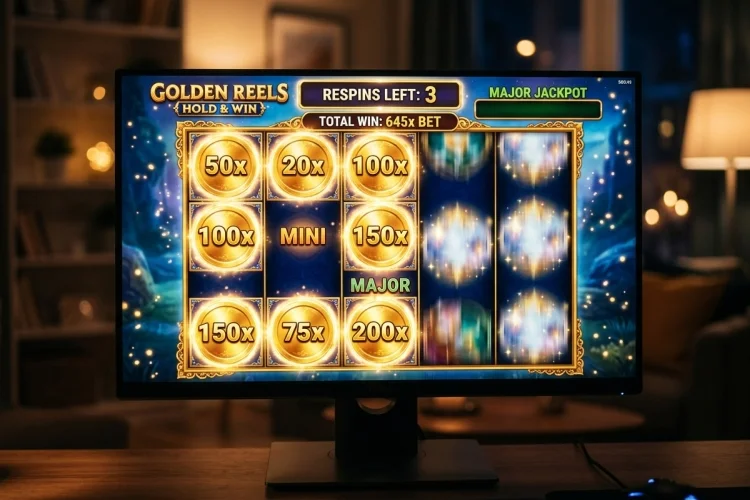

Two online slots can use the same five-reel layout, similar symbols, and even the same 96% RTP while feeling completely different to play. One produces regular small wins, while the other can stay quiet for dozens of spins before delivering a much larger payout.
The reason sits beneath the artwork: the game’s mathematical design. What Is a Slot’s Math Model?
In simple terms, it is the set of probabilities, payouts, reel structures, features, and rules that determines how a slot behaves over time. Understanding it helps explain almost every important slot statistic.
What Is Included in a Slot Math Model?
A slot’s math model is essentially the blueprint behind its payouts.
It determines which outcomes are possible, how frequently they can occur, how much each outcome pays, and how all those possibilities combine into the game’s theoretical return.
Independent testing laboratory GLI explains that mathematical evaluation can calculate or simulate possible game combinations to establish characteristics such as RTP, contributions from the base game, features and jackpots, as well as volatility.
That means RTP is only one output of the model rather than the entire model itself.
Two games could both have a 96% theoretical return but allocate that return across very different types of winning outcomes.
RTP Is One Target of the Math Model
Return to Player is probably the best-known number produced by slot mathematics.
If a game is designed at 96% RTP, its complete collection of possible outcomes and prize values must mathematically average toward roughly 96% of wagered money being returned over sufficiently large samples.
That does not mean a player receives $96 for every $100 wagered.
The UK Gambling Commission describes theoretical RTP as the designed percentage of the game and notes that actual RTP can move above or below it, particularly when the amount of observed play is limited.
The math model creates that long-term target through thousands – or potentially far more – possible outcome combinations.
Reel Weighting Controls Symbol Probability
The symbols displayed on a slot do not necessarily have equal probabilities.
A premium symbol could appear less frequently in the underlying mathematical reel structure than a low-paying symbol, even if both look equally prominent on screen.
Imagine a simplified reel containing 100 possible mathematical positions. A low-value fruit symbol might occupy 20 positions while a premium symbol occupies only four.
That would make the premium symbol significantly harder to land.
Modern digital slots can use virtual reel structures and more complicated weighting systems rather than relying only on the physical-looking positions visible during the animation.
This is one of the reasons counting visible symbols is not enough to reverse-engineer a game’s true probablity.
RNG Mapping Connects Random Numbers to Reel Outcomes
The math model works together with the Random Number Generator.
An RNG produces random values. Those values then need to be converted into meaningful game outcomes.
The UK Gambling Commission calls that process mapping. Its technical definitions describe mapping as using the result from an RNG to select an outcome—for example, converting it into a reel-strip symbol.
So the RNG provides randomness, while the game’s mathematical structure determines what the possible mapped outcomes mean.
Testing procedures can therefore examine both sides. UK regulatory testing includes verification of RNG implementation, mathematical design, theoretical RTP, game rules, and the scaling or mapping used to convert RNG output into game results.
The reels spinning on screen are only the visible presentation of that deeper system.
Volatility Determines How the Return Is Distributed
RTP tells you the theoretical amount returned over time. Volatility helps describe how unevenly that return may arrive.
The UK Gambling Commission explains that high-volatility games can contain prizes in the “very large but rare” category, while low-volatility games tend to consist more heavily of smaller, more frequent prizes.
Consider two hypothetical 96% RTP slots.
Slot A might generate frequent wins between 0.5x and 20x the stake.
Slot B could have fewer ordinary payouts but include occasional 1,000x, 5,000x, or larger results.
Their long-term RTP target might be identical, yet their session behaviour would feel completely seperate.
That difference comes directly from the mathematical model.
Hit Frequency Is Another Design Choice
Hit frequency generally describes how often a game produces a qualifying winning result.
A developer could design a slot with a relatively high hit rate but mostly small prizes. Another could generate fewer winning rounds while placing more payout value into larger wins.
This means hit frequency cannot be inferred directly from RTP.
For example, a game could pay something on roughly 30% of spins while still having 96% RTP. Another 96% game could theoretically produce wins less often but award larger amounts when they occur.
Even then, a “winning” spin is not necessarily profitable.
A $1 wager returning $0.50 may count as a paying result according to a game’s statistics, yet the player’s balance has still fallen by $0.50.
Math models have to account for all of these payout sizes and frequencies together.
Bonus Features Have Their Own Mathematics
Free spins, multipliers, respins, wilds, and jackpots are not separate from the math model.
They are part of it.
Suppose a game has a bonus that activates on average relatively rarely but can award very large multipliers. Some portion of the overall RTP may be mathematically allocated to that feature.
GLI’s game mathematics analysis specifically separates possible RTP contributions from the base game, feature games, and jackpots.
This explains why certain slots can feel quiet outside their bonus round.
A significant portion of their theoretical value may be concentrated inside the feature rather than distributed evenly throughout regular spins.
Feature frequecy, average feature payout, retrigger probabilities, multiplier distributions, and maximum-win rules can all form part of the same mathematical architecture.
Maximum Win Is Also Engineered Into the Model
A maximum win of 10,000x does not appear simply because the developer chooses an impressive marketing number.
The game needs mathematical paths capable of generating that result.
Perhaps the player needs premium symbols during free spins plus several multiplier wilds. Another slot might require repeated cascades that build an increasing multiplier.
Those rare top-end events also affect volatility and RTP.
If the model allocates more value to extremely large prizes, other parts of the payout structure generally have to be balanced accordingly to maintain the intended theoretical return.
This is why a huge maximum win does not automatically indicate better value.
It describes one extreme part of the payout distribution.
How Are Slot Math Models Tested?
Regulated markets can require independent testing before gambling software is released.
UK Gambling Commission procedures include verification of game design, mathematics, rules, theoretical RTP, RNG implementation, and simulated or manual testing of actual results.
GLI similarly states that mathematicians can evaluate payout combinations or run simulations when the total number of combinations becomes extremely large.
The objective is not to ensure players win regularly.
It is to verify that the implemented software behaves according to its approved rules and mathemetical specifications.
Player-facing rules must also provide information that helps customers understand factors such as the game’s operation, prizes, RTP, house edge, or likelihood of winning where applicable.
So, What Is a Slot’s Math Model? It is the complete probability and payout structure behind the game, combining RTP, volatility, symbol weighting, winning combinations, bonuses, jackpots, and maximum payouts.
Understanding the model will not predict your next spin, but it helps explain why slots with similar graphics or RTP can behave so differently. Check the paytable, RTP, volatility, and feature rules to understand the game beyond its artwork.